
Coat of Arms Rings: What the Design Shows and How It Reads
What a Coat of Arms Ring Is
Strictly speaking, the "coat of arms" is the design on the shield. The full package, shield plus helmet, crest, mantling, motto and sometimes supporters on either side, is called an achievement. In everyday speech nobody bothers with the distinction, and a coat of arms ring is simply a signet ring engraved with a family's heraldic design.
That distinction matters the moment you sit down to plan the ring, though. A signet face is about the size of a thumbnail. You can't fit an achievement on it, so you have to decide which piece of the heraldry does the talking. Some people put the shield on the face. Others use only the crest, the figure that sits above the helmet, such as a lion, a hand holding a sword or a bird with its wings half open. Others use a monogram and keep the heraldry for a second ring.
Signet rings themselves are old. They began as working tools, engraved so the wearer could press a personal mark into wax or clay and prove a letter or document was theirs. The Wikipedia article on signet rings traces the type back thousands of years, long before heraldry existed. Coats of arms arrived in medieval Europe as a way of identifying armoured knights, and the two traditions merged because a ring was the obvious place to carry your identifying mark.
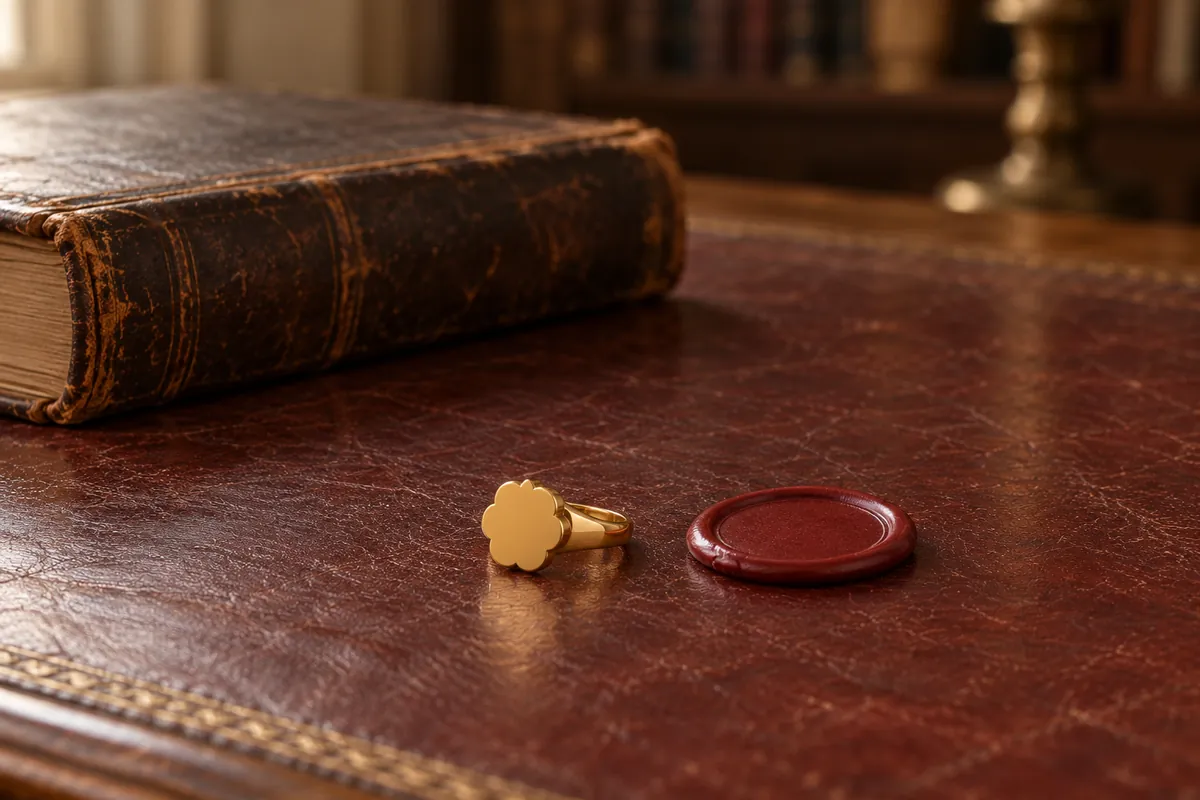
One thing to know about Crest rings: the faces are laser-engraved. That's a shallow cut, so the ring is a piece of jewellery and an heirloom, not a working seal. It can't press sealing wax. If you want a ring that signs letters, this isn't the one, and it's better to know that up front.
Another fact worth having straight before you start: historically, arms belonged to an individual and passed to that person's descendants. They didn't belong to a surname as a whole. The Wikipedia entry on coats of arms covers this in more detail. So if you found a "family crest" on a souvenir mug for your surname, treat it as a starting point for research and not as proof the design is yours. Bring a design you can trace to your own family papers, a grant, a book plate or an old seal.
Reading the Design on the Shield
Heraldry has its own language, and it's worth learning ten minutes' worth, because it tells you what's essential on the ring and what you can drop.
The written description of a coat of arms is called a blazon, and it follows a strict order: the colour of the field (the background) first, then the main charge (the picture on it), then smaller ones. "Azure, a lion rampant or" means a blue shield with a gold lion standing on its hind legs. The Wikipedia page on blazon explains the grammar, and it's the single most useful thing to have in your hand before you brief an engraver. If your family's blazon is on record, the ring can be built from that text and not from a blurry photocopy of a photocopy.
Tinctures
Heraldic colours are called tinctures. There are two metals, or (gold) and argent (silver), and a handful of colours: gules (red), azure (blue), vert (green), sable (black) and purpure (purple), plus furs such as ermine. The general rule is that colour doesn't sit on colour and metal doesn't sit on metal, which is why you see a gold lion on a blue field and not a blue lion on a green one. The Wikipedia article on tinctures lists them all.
Here's the catch for a ring. A gold face is one colour. The reds, blues and greens of the shield don't exist in the metal. Engravers have long dealt with this by using hatching, a set of line and dot patterns that stand for each tincture, which the same Wikipedia article describes. On a small ring face the practical outcome is that the shapes carry the meaning. The lion has to look like a lion, and the chevron has to look like a chevron. The colour is background knowledge you, the wearer, carry in your head.
Charges and divisions
The pictures on a shield are charges. Animals, plants, tools, towers, stars, crescents and crosses are all common. The bold geometric shapes are ordinaries: the chevron (an inverted V), the fess (a horizontal band), the pale (a vertical band), the bend (a diagonal). Many old coats are built from just one or two of these, which is good news for a ring, because they survive being shrunk. A shield divided into four quarters with a different charge in each, on the other hand, can be a struggle at ring scale.
A tip worth keeping: when you look at your coat of arms, ask what a stranger would spot at arm's length. That's what the ring face will preserve. The rest is texture.
Choosing the Right Coat of Arms Ring
Start with the artwork, then choose the ring that suits it. Plenty of people do it the other way round, fall for a shape and then try to cram a crowded design into it. It rarely ends well.
Shield or crest? If your arms have a bold, simple shield (one main charge, maybe a band), use the shield. If the shield is busy but the crest is a single clear figure, use the crest. A crest on its own has been the traditional signet choice for centuries for exactly this reason: it's compact. The Wikipedia article on heraldic crests explains how the crest relates to the rest of the achievement.
Count the elements. A good working limit for a face this size is three distinct things: say, a shield outline, one main charge and one small detail. Past that, lines start to crowd each other. If your coat has six charges, you'll have to choose, and the choice should be the oldest or most meaningful one. Your family may disagree about which that is, so settle it before you brief anyone.
Mind the outline. A shield can sit well on a square or soft-square face, with room around its outline. A round-bottomed heater shield leaves space in the corners, which you can keep plain or use for a border. Think about that space before you see the proof.
Think about initials or a motto. If the arms are too intricate to shrink, a monogram face is a perfectly respectable alternative, and it's worth reading about the different ways initials sit on a ring. Motto scrolls are usually the first casualty, since the lettering is tiny. They look better engraved on a second surface or kept for a different piece.
Also decide which hand it's going on before the ring is sized and the design orientation is fixed. The guide to wearing a signet ring on the left or right hand covers the tradition. Short version: the little finger of the hand you don't write with is traditional, the ring finger is also traditional, and the index finger is common today.
Top Styles and Shapes
The face shape is the frame for your design, and Crest makes a range of them in the signet rings collection. A few that suit heraldic work in particular:
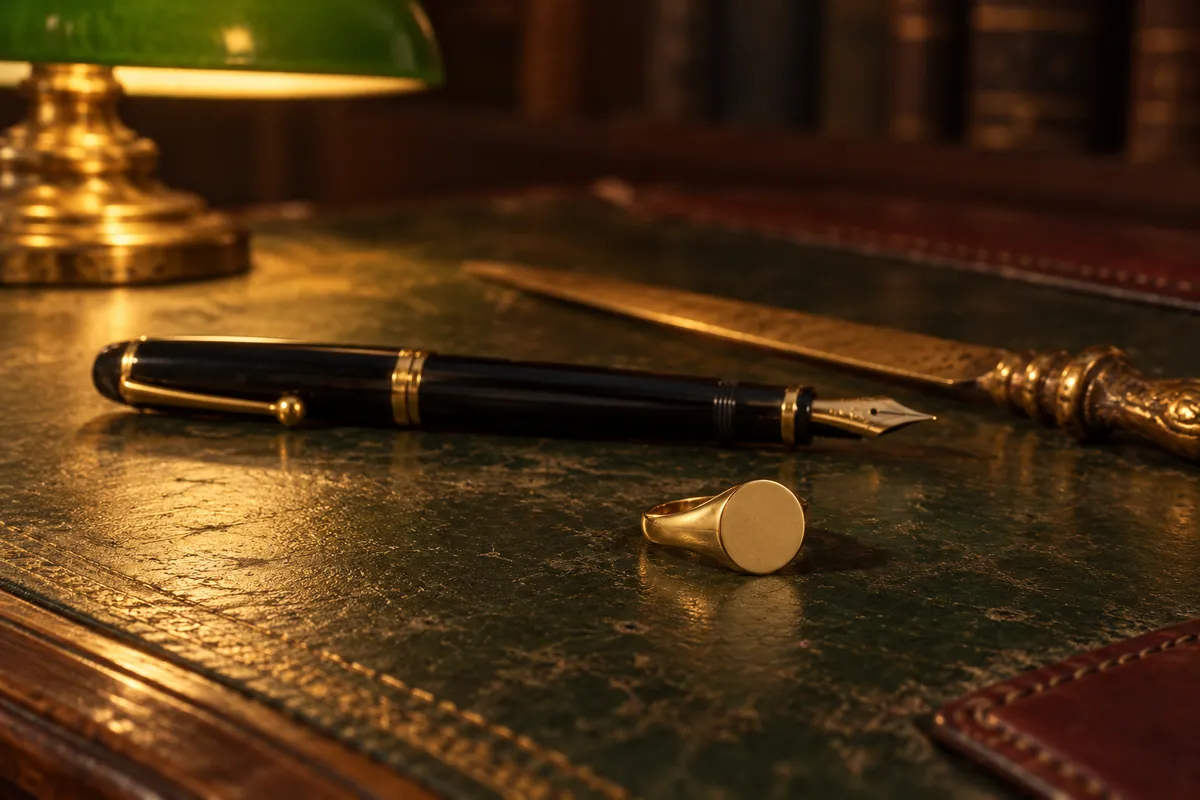
The Bequest is a classic oval, built for a crest. The oval is the traditional signet shape, and a single upright figure (a lion, a stag, an arm holding a sword) sits comfortably inside it. If you're after the look of an old family ring, start with The Bequest.
For a shield with a bold charge, start with the square face of The Accord or the soft square of The Abbey. Leave enough space around the shield for its outline and main charge to read clearly. An upright crest can also sit comfortably on the classic oval of The Bequest.
The Bastion is a hexagon, made for an emblem. If your family mark is a badge, a device or a company-style symbol and not a classical shield, the six sides give it a firm, architectural frame. Look at The Bastion.
The Abbey is a soft square, and The Accord is a square. Square faces suit a symmetrical shield or a centred charge, where the lines of the design are strong and the corners can hold a little breathing space. Compare The Abbey and The Accord side by side.
For a botanical device, The Clover has a four-leaf clover face worth considering. Other choices include the cushion shape of The Bower, the concave rectangle of The Chancery and the octagon of The Keep, with the latter two intended for initials.
Metal colour is a separate decision. Traditional yellow gold reads as the "heirloom" choice, but there is a rose gold option if you prefer a warmer tone. Since a shallow engraving shows up through contrast in light and shadow, a polished face with a clear design is what you're after, whichever colour you choose.
What to Check Before You Buy
Your artwork. Gather the best source you can: a blazon, a scan of a grant of arms, a book plate, a clean drawing from a family history. A phone photo of a framed print with glare on it is the weakest starting point. If you only have a low-quality image, say so, and expect to simplify.
The proof. Crest makes rings to order, and nothing is cast until you approve a proof. That proof is your one chance to catch problems: a missing detail, a charge facing the wrong way, a crowded corner. Look at it at actual size if you can, not zoomed to fill a screen. A good test is to print it at about the dimensions of the face and hold it at arm's length. If you can still tell what it is, it'll work on the finger.
Size. This is the part people skip, and it's the part that can't be undone, because once the proof is approved the ring is final sale, size included. Sizes run US 5 to US 13.5 (about J to Z+2 in AU/UK sizing). Measure the exact finger you plan to wear it on, at the end of the day when your hands are warm. A signet sits best a little snug, since the face is heavier than a plain band and tends to rotate if loose. If you land between sizes, choose the larger. The site's FAQ page has the full sizing guidance.
Identification. Every ring carries a Register number laser-engraved inside the band. It's a small thing, but it gives your ring its own record, and you can read about how that works on The Register page.
Aftercare. A shallow engraving collects skin oil and grime in the recesses over time. A soft brush and mild soapy water will keep the lines crisp, and the care page has the specifics. Faults in the making are covered by warranty, but everyday knocks and wear are down to you.
Tips from the Experts
Heraldic designers have been fighting the same battle for a few hundred years: too much on too small a surface. Here's what tends to help.
Cut the clutter before it's engraved. It's easier to remove a detail at the drawing stage than to explain after the fact why it vanished. If you're torn, drop the smallest element first. A tiny star or a fine border line is usually the first thing to blur.
Keep the silhouette strong. The outline of a charge does most of the work. A lion in profile reads as a lion even if the mane detail is simplified. A bird with spread wings reads as a bird. If the outline is ambiguous, no amount of interior detail will rescue it.
Be wary of shortcuts. Heraldry used to be a serious business, and it's tempting to ask for a quick merge of two families' arms or to "tidy" a charge for looks. If the design matters to your family, keep it accurate and let any simplification be deliberate, not accidental.
Match the ring to its job. If it's a gift for a milestone birthday or a graduation, a crest on a classic oval is hard to fault. If it's the first ring you've ever worn, a bolder shape with a plain design may sit better. If you wear a ring daily while working with your hands, think about how a raised, heavy face will behave at the bench or on a keyboard. That's a practical question, and it's one worth asking yourself before you choose.
Read around it. The Crest journal has more on the history and etiquette of signet rings, and the main site shows the full range.
Frequently Asked Questions
What is the best coat of arms ring?
The best one is the one where the design stays legible at thumbnail size. A bold shield on the square face of The Accord or soft square of The Abbey, or a single clear crest on the oval face of The Bequest, will beat a crowded design on any shape.
How do I know which coat of arms ring is right for me?
Begin with your artwork and count the elements. If you have three or fewer, the full shield will likely fit; if you have more, choose the crest or the strongest charge. Then pick the face shape and the finger you'll wear it on.
What should I look for when buying coat of arms ring?
Check that your source artwork is clear, that the maker works from a proof you approve, and that you've measured your finger properly at the end of the day. Remember that the faces are laser-engraved and shallow, so the ring is a piece of jewellery and not a working wax seal.
What happens once I approve my proof?
Only then is the ring cast, made to order in Australia. From that point it's final sale, size included, so check the design and the size carefully first. Faults in the making are covered by warranty.
References & Sources
Every signet is made to order, and nothing is cast until you approve your proof.
See the signet rings