Signet Ring Engraving Ideas: Initials, Monograms and Crests
What Signet Ring Engraving Means
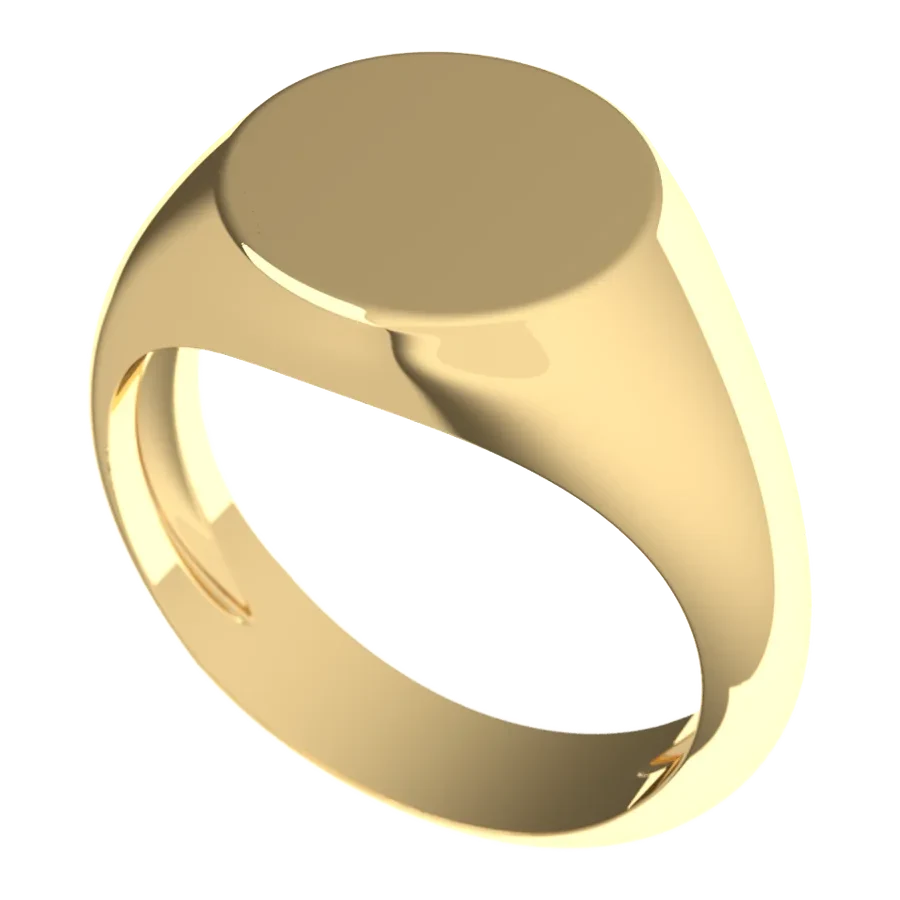
A signet ring is a ring with a flat face made to carry a personal mark. Historically that mark was pressed into soft wax to seal a letter or a document, and the ring doubled as proof the message came from you. Wikipedia's entry on the signet ring traces the practice back thousands of years, which is a decent run for a piece of jewellery.
These days the engraving is the whole point. The gold is the frame, and what's cut into the face is what makes the ring yours rather than a plain band with a flat top. People choose initials, a monogram, a family crest, or a simple emblem that means something to them.
One practical detail worth knowing early: Crest faces are laser-engraved for crisp, fine detail. If you want to press your ring into sealing wax, ask for the Deep seal face before you order: it is made for pressing wax, and we'll quote it for you.
If you're still working out what a signet ring even looks like on a hand, browse the signet rings range first. Seeing the face shapes side by side makes the engraving decision much easier.
How to Choose Your Engraving
Start with what the face should say
Ask one question before anything else: should a stranger be able to read this, or only you and your family? Initials are readable by anyone. A crest is closer to a private language, and that's part of its appeal. Neither answer is wrong, but you should know which one you want before you sit down with a design.
Then think about how much detail you're asking a small surface to hold. A signet face is roughly the size of a fingernail or smaller. A single bold initial, a pair of letters, or a crest with a few clear elements will look sharp. A full coat of arms with mantling, supporters and a motto ribbon reads best when it's simplified for that scale.
Match the shape to the engraving
The face shape does a lot of the work, and some shapes suit certain designs better than others:
- The Bequest is a classic oval, and it's the natural frame for a crest.
- The Bastion is a hexagon, built for an emblem.
- The Abbey is a soft square, and The Accord is a straight-edged square. Both give a block of initials or a compact monogram an even, balanced field.
- The Bower is a cushion shape, softer than a square and a good home for a rounded monogram.
- The Chancery (a concave rectangle) and the Keep (an octagon) are both intended for initials.
A tall letter like an L or a J sits happily in a vertical oval. A wide arrangement of three letters sits better in a square or a rectangle. It sounds fussy, but putting the wrong shape under the wrong design is the quickest way to end up with a ring that looks slightly off and you can't say why.
Think about the hand it will live on
The traditional finger is the little finger of the hand you don't write with. The ring finger is also traditional, and the index finger is common today. If you're unsure which hand and finger, the journal piece on wearing a signet ring on the left or right hand covers the reasoning. It matters for engraving because a little finger usually suggests a smaller, simpler face than an index finger does.
Top Engraving Styles and Options
A single initial
One letter, large, centred. It's the cleanest option and the one that ages best, because there's nothing in it to date. A single initial works especially well on a square or cushion face, where the letter can fill the space without fighting a border. If you've never had a signet ring, this is a safe place to start.
Two or three initials
Two letters (first and last name) or three (first, middle, last) is the classic arrangement. The usual convention in a three-letter monogram is to make the middle letter, the surname, the largest. Wikipedia's page on monograms describes how monograms combine letters into a single motif, and notes that arrangements vary. Pick the order that reads naturally to you and say so clearly when you brief the design.
An interlaced monogram
Here the letters overlap or weave through one another. It looks elegant, but it asks the most of a small face, because every crossing point is a place where detail can blur. Keep the letterforms simple (a plain serif or a clean block) and the monogram stays legible. For an interlaced script monogram, check the proof at actual size to confirm the letters read clearly.
A family crest
This is what many people picture when they hear "signet ring". In everyday speech "crest" often means the whole coat of arms, though in strict heraldry the crest is only the figure that sits above the helmet. Wikipedia's article on the heraldic crest explains the distinction. For a ring, the practical question is simpler: which part of your design will still be clear when it's the size of a postage-stamp corner?
If you have a family design, start by finding what's actually on record for it. Our journal piece on coat of arms rings and how the design reads walks through what each part of a design shows, which helps you decide what to keep and what to drop.
A full coat of arms, simplified
A coat of arms can carry a shield, helmet, mantling, crest, supporters and a motto. On a ring you'll almost always want the shield and perhaps the crest, and nothing else. Mottos in particular are tiny text, and tiny text is the first thing to lose clarity. If the motto matters, consider keeping it for the inside or for a different piece entirely.
An emblem that's yours
Not everyone has a family crest, and that's fine. A symbol with a story attached (a tree, a boat, a mountain outline, a flower) makes a good signet face because it's personal and simple. The Bastion's hexagon was designed with exactly this kind of emblem in mind. The test is the same as for everything else: can you sketch it in five strokes and still recognise it?
Choosing the gold colour
The engraving reads a little differently depending on the metal around it. The warm tone of rose gold signet rings gives a softer look than a classic yellow, so it's worth viewing the same face in each before you settle.
What to Check Before You Buy
Nothing is cast until you approve the proof
Crest rings are made to order in Australia, and nothing is cast until you approve a proof of the design. That proof is your moment to catch problems: a letter in the wrong order, a crest element that's too fine, a face shape that doesn't suit the design. Look at it properly. Print it at actual size if you can, hold it at arm's length, and show it to someone who hasn't seen it before.
Once the proof is approved the ring is final sale, including the size. That's the reason to be thorough now rather than hopeful later. Faults in the ring itself are covered by warranty, but a change of mind about the design or the size isn't a fault.
Get the size right first
Sizes run from US 5 to US 13.5 (AU/UK J to roughly Z+2). Measure the exact finger at the end of the day, when your hands are warm and at their largest. A signet sits best a little snug, because the face is heavier than a plain band and tends to rotate on a loose fit. If you land between sizes, choose the larger one.
A ring that spins around so the engraving ends up under your finger defeats the purpose, so give sizing as much attention as the design. The Crest FAQ page has the sizing and ordering details in one place.
Know what's inside the band
Each ring has a Register number laser-engraved inside the band. It's a small thing, but it gives your ring its own identity record. You can read about how it works on the Register page.
Plan for the long haul
A signet is worn every day, so how you look after it matters. Wear and cleaning habits are covered on the care page, and it's worth a read before the ring arrives rather than after.
Expert Tips for a Clean Result
Cut elements until it hurts, then cut one more. Most engraving briefs are over-stuffed. A face with three clear things beats a face with seven fighting for space. If you can't decide between two details, pick the one that's easier to recognise at a glance.
Keep a proper border. Leave some space between the design and the edge of the face. Engraving that runs right to the edge looks cramped and can feel unfinished on the finger. Space around a design reads as confidence.
Prefer bold lines to hairlines. Thin strokes are the first casualty on a small face. When you look at your design, imagine it shrunk to about the size of your thumbnail. Anything that disappears at that size is a candidate for deletion.
Think about orientation. Traditional seal matrices were cut in mirror image so the wax impression would read the right way round, a point covered in Wikipedia's article on seals. On a standard Crest face, what you see on the proof is what you'll read on your finger. Check letter order and direction on that proof, not in your head.
Choose something you'll still like in twenty years. Initials and a clean crest age gently. A joke, a trend or a current obsession tends not to. A signet ring is the kind of thing people hand down, so design for the person who'll inherit it, not just for yourself this year.
If you want more reading before you commit, the Crest journal has further articles on signet ring history and design, and the Crest Signet Rings home page is the place to start if you'd like to see the full range.
FAQ: Frequently Asked Questions
What is the best signet ring engraving ideas?
For most people, the best choice is the simplest one that still means something: one to three initials, or a single clear crest element. Small faces reward bold, uncluttered designs, and those also age better than detailed ones. If you have a family crest, simplify it to the shield or the crest figure rather than squeezing in every part.
How do I know which engraving idea is right for me?
Decide first whether the ring should be readable by anyone (initials) or personal to you and your family (a crest or emblem). Then sketch the idea at thumbnail size and see if it still reads. If it does, and you'd be happy wearing it in twenty years, it's the right one.
What should I look for when choosing an engraving?
Look for clear shapes, bold lines and some space between the design and the edge of the face. Match the design to the face shape, such as an oval for a crest or a square for initials. Get your size right too, since a signet sits best a little snug and the size is final once the proof is approved.
What happens once I approve my proof?
Your ring is made to order and nothing is cast until you approve the proof. After approval the ring is final sale, including the size, so check the design and your measurement before you say yes. Faults in the ring itself are covered by warranty.
References & Sources
Every signet is made to order, and nothing is cast until you approve your proof.
See the signet rings